Read More

Your shopping bag is empty
Go to the shop
When most riders look at carbon fiber, they usually notice the visual pattern first: the sharp diagonal lines, symmetrical grids, or technical layered textures. But those patterns are not just for appearance.
Different carbon fiber weave patterns are designed for specific purposes, influencing everything from flexibility and stiffness to manufacturing complexity and overall performance.
But not all carbon fiber looks the same.
If you have ever searched for carbon fiber motorcycle parts, you have likely come across terms like:
At first glance, these seem purely cosmetic differences. In reality, carbon weave patterns influence not only the appearance of the part, but also manufacturing behavior, flexibility, stiffness, weight distribution, and even pricing.
For motorcycle enthusiasts, especially, choosing the right carbon weave pattern is often a combination of: performance goals, visual preference, durability expectations, and budget.
This guide breaks down the major types of carbon fiber weave patterns, how they compare, and how to choose the right one for your motorcycle build.
Carbon fiber itself is made from extremely thin strands of carbon woven together into sheets. These sheets are then layered with resin and cured to create lightweight yet incredibly strong components.
The visible design you see on the surface of a carbon fiber part is known as the weave pattern.
Think of carbon fiber like a woven fabric. Just as different fabric patterns create different looks and textures, different carbon fiber weave patterns change how the material looks, feels, bends, and performs.
The final weave pattern depends on:
Although carbon fiber weave patterns are often chosen for their visual appeal, they also play a major role in how a component performs and behaves. Different weave styles can influence rigidity, flexibility, load distribution, surface finish, manufacturing complexity, and even the overall cost of the final product. Some weave patterns offer better structural stability and stiffness, while others are easier to mold around complex curves and aerodynamic shapes.
In the motorcycle industry, carbon fiber weave patterns are used in both performance-focused and cosmetic components. They are commonly found in fairings, exhaust covers, front fenders, tank panels, heat shields, side covers, chain guards, wheel components, and aerodynamic accessories. Manufacturers select different weave patterns depending on the balance they want between lightweight performance, durability, structural strength, and premium styling.
Some riders prefer the classic motorsport appearance of twill weave, while others prefer the futuristic, fragmented look of forged carbon.
Understanding the differences helps you make smarter choices when upgrading your motorcycle.
Not all carbon fiber weave patterns are built the same. Each weave style has its own unique appearance, structural behavior, flexibility characteristics, and manufacturing advantages. Some are designed primarily for lightweight performance and rigidity, while others focus more on visual appeal and ease of shaping around complex motorcycle bodywork. Understanding the differences between these weave patterns helps riders choose the right carbon fiber components based on their performance needs, styling preferences, and overall motorcycle design.
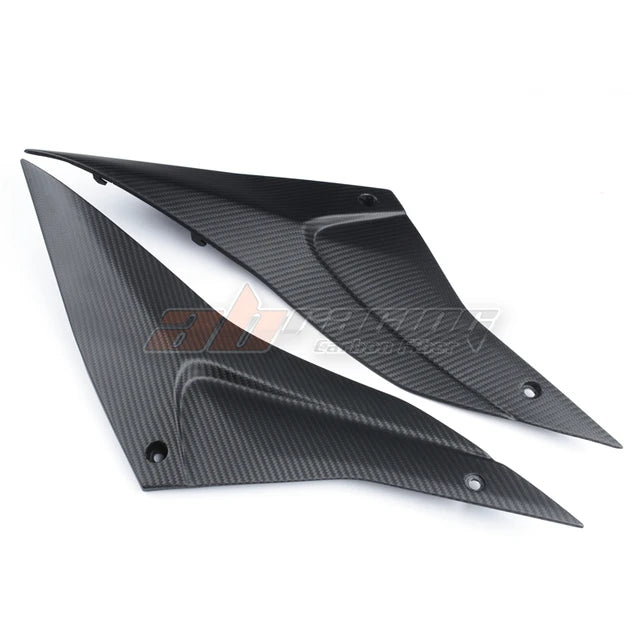
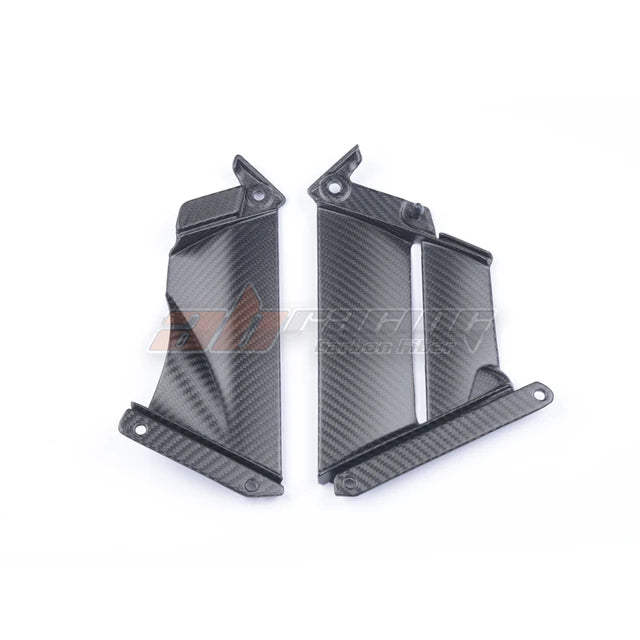
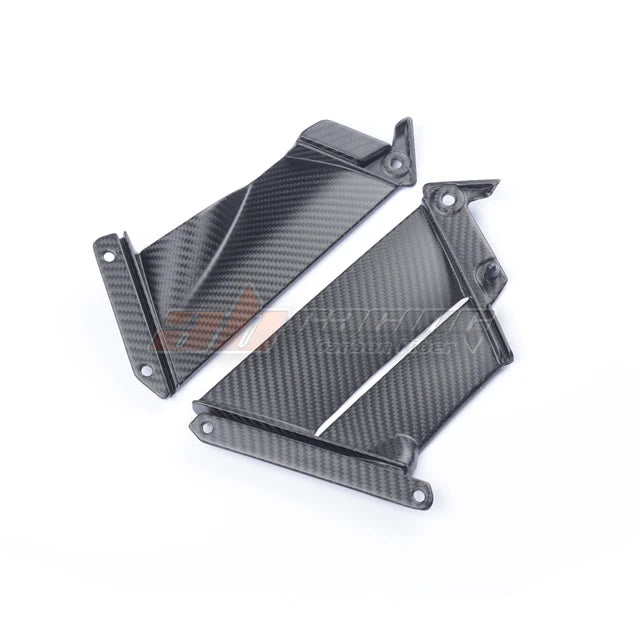
Twill weave is one of the most popular and recognizable carbon fiber patterns in the motorcycle industry. In this weave style, each carbon strand passes over and under multiple strands in an offset pattern, creating the signature diagonal design that gives carbon fiber its aggressive motorsport appearance. Twill weave is widely used because it offers an excellent balance of flexibility, strength, and premium visual appeal, especially on curved motorcycle body panels and aerodynamic components.
Key Characteristics
Why Riders Love It
Twill weave looks aggressive and high-end. It reflects light beautifully, giving parts a deep and a premium appearance.
Because the weave conforms well around complex shapes, manufacturers commonly use twill carbon for: motorcycle fairings, fuel tank covers, side panels, and aerodynamic bodywork.
|
Advantages |
Disadvantages |
|
Excellent visual appeal with a premium finish |
Slightly more flexible than plain weave |
|
Easier to mold around curved and complex surfaces |
Cosmetic weave distortion can occur on tight curves |
|
Widely available across the motorcycle aftermarket parts |
Premium-grade twill carbon can become expensive |
|
Balanced stiffness and flexibility for practical use |
Requires careful manufacturing for perfect alignment |
|
Commonly used in racing and performance applications |
Minor imperfections are more visible due to the glossy pattern |
Common Motorcycle Applications
|
Feature |
Twill Weave |
|---|---|
|
Appearance |
Diagonal pattern |
|
Flexibility |
High |
|
Stiffness |
Moderate to high |
|
Visual Appeal |
Excellent |
|
Cost |
Moderate to premium |
|
Common Use |
Fairings and body panels |
Plain-weave carbon fiber uses a simple over-under-over-under pattern that creates a clean, highly symmetrical checkerboard appearance. Because of its tightly woven structure, it offers excellent stability, durability, and resistance to weave distortion during manufacturing. Plain weave is commonly used in motorcycle parts where structural consistency and a precise technical look are important.
Key Characteristics
Why It’s Popular
Plain weave is more stable during manufacturing and less likely to distort.
It is commonly used when:
|
Advantages |
Disadvantages |
|
Strong structural stability |
Less flexible around complex curves |
|
Minimal weave distortion during manufacturing |
Can appear less visually aggressive than twill weave |
|
Clean and symmetrical appearance |
Slightly harder to shape around sharp contours |
|
Durable and consistent surface finish |
Less suitable for highly aerodynamic bodywork |
|
Excellent for flat and rigid components |
Limited drapability during manufacturing |
Common Motorcycle Applications
|
Feature |
Plain Weave |
|
Appearance |
Checkerboard |
|
Flexibility |
Moderate |
|
Stiffness |
High |
|
Visual Appeal |
Clean and technical |
|
Cost |
Moderate |
|
Common Use |
Structural and flat components |
Unidirectional (UD) carbon fiber aligns all fibers in a single direction rather than weaving them together, creating a clean, linear appearance. This structure allows the material to deliver extremely high strength and stiffness along the fiber direction, making it ideal for performance-focused and structural motorcycle components where lightweight rigidity is a priority.
Key Characteristics
Why Engineers Use It
UD carbon is heavily used in aerospace and motorsports because engineers can place stiffness exactly where needed.
|
Advantages |
Disadvantages |
|
Extremely high stiffness in a single direction |
Less visually dramatic than woven carbon fiber |
|
Very lightweight construction |
Lower strength when force comes from multiple directions |
|
Excellent load-bearing capability |
Often needs additional woven layers for reinforcement |
|
Ideal for high-performance engineering applications |
More technical and industrial-looking appearance |
|
Commonly used in motorsports and aerospace |
Manufacturing and layering require high precision |
Common Motorcycle Applications
|
Feature |
UD Carbon |
|
Appearance |
Linear |
|
Flexibility |
Direction dependent |
|
Stiffness |
Very high |
|
Visual Appeal |
Technical |
|
Cost |
Premium |
|
Common Use |
Structural performance parts |
Honeycomb carbon fiber uses a lightweight hexagonal core structure placed between layers of carbon fiber to improve rigidity while keeping weight extremely low. This construction is commonly used in high-performance racing and aerospace applications where maximum strength, stiffness, and structural efficiency are required.
Key Characteristics
|
Advantages |
Disadvantages |
|
Extremely lightweight construction |
Expensive compared to standard weave patterns |
|
Excellent rigidity and structural strength |
Complex manufacturing process |
|
Strong impact resistance |
Mostly limited to advanced or racing applications |
|
Ideal for high-performance motorsport use |
Less commonly available in regular aftermarket parts |
|
Designed for demanding engineering environments |
Repairs and replacements can be costly |
Common Motorcycle Applications
|
Feature |
Honeycomb Carbon |
|
Appearance |
Layered composite |
|
Flexibility |
Low |
|
Stiffness |
Very high |
|
Visual Appeal |
Technical |
|
Cost |
High |
|
Common Use |
Racing and aerospace-style components |
For motorcycle enthusiasts, the right weave often depends on the intended use of the part: aggressive track riding, lightweight engineering, daily durability, or simply creating a premium high-end appearance. Understanding how these weave patterns compare side-by-side helps riders choose the ideal balance between aesthetics, stiffness, flexibility, weight, and cost.
|
Weave Type |
Appearance |
Flexibility |
Stiffness |
Cost |
Best For |
|
Twill Weave |
Aggressive diagonal |
High |
Moderate-High |
Moderate |
Body panels |
|
Plain Weave |
Symmetrical |
Moderate |
High |
Moderate |
Structural parts |
|
UD Carbon |
Linear |
Directional |
Very high |
Premium |
Performance engineering |
|
Honeycomb |
Technical |
Low |
Extremely high |
High |
Racing applications |
This largely depends on personal taste.
Most premium motorcycle manufacturers still heavily favor twill weave for exterior components because it balances beauty and functionality.
Many riders assume all carbon fiber performs the same, but the weave pattern and fiber layout actually have a major impact on how a part behaves. Different weave structures affect stiffness, flexibility, strength distribution, durability, and even how the motorcycle feels while riding. That is why manufacturers carefully choose specific carbon fiber constructions depending on whether the goal is lightweight performance, structural rigidity, aerodynamic shaping, or luxurious appearance.
Carbon fiber is strongest when force travels in the same direction as the fibers themselves. This is one of the most important principles in carbon fiber engineering. When force is applied along the fiber direction, the material becomes extremely stiff and strong. When force comes from other angles, the strength decreases.
|
Fiber Orientation |
Strength Level |
Performance Characteristic |
|
0° (Parallel to force) |
Very High |
Maximum stiffness and strength |
|
45° (Diagonal) |
Moderate |
Helps resist twisting and torsional loads |
|
90° (Perpendicular to force) |
Lower |
Relies more on resin and layer support |
This multi-angle layering technique is widely used in racing motorcycles, aerospace engineering, and high-performance automotive applications because it creates strong yet lightweight structures.
Different weave patterns also change how flexible or rigid a carbon fiber part becomes.
Twill weave is slightly more flexible and easier to shape around aggressive curves and aerodynamic bodywork. This makes it ideal for motorcycle fairings, tank covers, and complex panels.
Plain weave is generally more rigid and dimensionally stable. It resists distortion well and maintains a cleaner, more uniform structure during manufacturing.
|
Weave Type |
Flexibility |
Rigidity |
Best Application |
|
Twill Weave |
High |
Moderate-High |
Curved body panels |
|
Plain Weave |
Moderate |
High |
Structural stability |
|
UD Carbon |
Low flexibility |
Extremely High |
Performance engineering |
For example, plain weave carbon often provides excellent structural consistency and resistance to distortion, while UD carbon prioritizes stiffness and weight-saving performance. This is why many premium carbon fiber parts combine multiple weave styles and fiber orientations together to achieve the ideal balance of strength, durability, and weight reduction.
Many people assume the weave pattern itself determines heat resistance, but that is only partly true. Heat performance depends more on:
High-end carbon fiber components often use aerospace-grade resins, UV-resistant coatings, and advanced curing methods to improve durability against: engine heat, sunlight, road debris, vibration, and weather exposure.
This becomes especially important for motorcycle exhaust shields, engine covers, and high-temperature performance components.
Cheap carbon fiber parts often contain excess resin, which increases weight without improving strength. Premium carbon fiber components use optimized resin-to-fiber ratios to maximize stiffness while keeping the part as lightweight as possible.
In high-performance motorcycles and racing applications, even small weight reductions can improve:
That is why advanced carbon fiber engineering remains such an important part of modern motorsports and premium motorcycle design.
Carbon fiber weave patterns are far more than just visual styling elements. The type of weave used can influence how a motorcycle part looks, feels, performs, and even how it is manufactured. From stiffness and flexibility to durability and weight reduction, every weave pattern brings its own unique characteristics to the table. That is why choosing the right carbon fiber weave is not only about appearance, but also about matching the part to its intended purpose and riding style.
For many riders, twill weave remains the go-to option because of its iconic motorsport look, balanced strength, and ability to complement aggressive sportbike designs. Riders looking for something more modern and attention-grabbing often lean toward forged carbon, which delivers a unique exotic appearance unlike traditional woven patterns. On the other hand, performance-focused riders and engineers may prefer unidirectional carbon and advanced composite structures for their exceptional stiffness and lightweight engineering benefits.
Ultimately, there is no single “best” carbon fiber weave pattern for every motorcycle. The ideal choice depends on what matters most to you: racing-inspired aesthetics, reduced-weight performance, premium craftsmanship, or creating a completely custom look. Carbon fiber has become such a major part of motorcycle culture because it perfectly blends engineering with emotion. And for most enthusiasts, the real satisfaction comes not only from improved performance, but also from looking at the bike in the garage and knowing it looks absolutely incredible.
Twill weave is the most popular choice because of its deep diagonal pattern and premium motorsport appearance. It reflects light beautifully, giving motorcycles a high-end, sporty look commonly seen on superbikes and racing machines. Riders who prefer a cleaner, more technical design often choose plain-weave carbon, as it offers a more symmetrical, uniform appearance.
The right carbon fiber weave depends on what matters most to you. Twill weave is ideal for aggressive sportbike styling and premium motorsport aesthetics, while plain weave offers a cleaner, more symmetrical, and technical appearance. UD (Unidirectional) carbon is commonly used for performance-focused engineering applications where maximum stiffness and lightweight strength are important. It is also a good idea to match the weave style to your motorcycle’s existing carbon parts to maintain a clean, consistent overall look.
Not significantly. Heat resistance depends more on the resin quality, manufacturing process, and overall construction than on the weave pattern itself. High-quality carbon fiber parts made with premium resins and proper curing methods can handle heat very effectively, whether they use twill, plain weave, or UD carbon fiber. This is especially important for motorcycle parts exposed to engine heat and exhaust temperatures.
Yes, the weave pattern can influence the price of carbon fiber parts. Standard twill-weave and plain-weave carbon are generally more affordable because they are widely used and easier to manufacture consistently. More advanced carbon fiber constructions and specialized manufacturing techniques often increase production costs due to the additional precision, materials, and finishing work involved. The final price also depends on factors like resin quality, layer construction, curing process, and overall manufacturing quality.
Yes, the weave pattern plays a major role in a motorcycle's overall look and visual character. Twill weave creates a bold, aggressive motorsport appearance, while plain weave offers a cleaner, more symmetrical design. The right weave pattern can enhance the premium feel of a motorcycle and help create a more cohesive styling theme across different carbon fiber parts.
UD (Unidirectional) carbon is generally the strongest in one specific direction because all fibers are aligned together. However, woven patterns like twill and plain weave often provide better overall multidirectional strength and durability, which is why many motorcycle parts combine multiple carbon fiber layers.
Yes, especially in structural and performance-focused components. Carbon fiber can reduce weight, improve rigidity, and enhance handling characteristics. However, for cosmetic parts like covers and trim pieces, the impact is usually more visual than performance-related, with the main benefit being the high-end look.
Twill weave is the most commonly used carbon fiber pattern in the motorcycle and automotive industry. Its diagonal design provides a premium styling while also offering good flexibility for molding around curved surfaces like fairings, tank covers, and side panels.
Yes, different carbon fiber weave patterns can be used on the same motorcycle, especially on custom or modified builds. However, many riders prefer a consistent weave across all carbon parts to maintain a cleaner, more uniform appearance. Matching the weave pattern across fairings, tank covers, side panels, and other components usually creates a more premium, factory-style finish.